Mari made her mother’s dreams come true. She became a musician, playing the violin in an orchestra in Ōita, Japan. She cared for her mother through dialysis and Alzheimer’s. She got married.
That was a lifetime ago. Because in Japan, Mari says, once women get married, they lose any agency or life of their own: “They are dead.”
Not one to stay dead, today Mari (she/her) is a single mother of two, a FareStart graduate and a woman on a mission to improve people’s health through medicine and food.
Mari began to make her own way at age 32, after filing for divorce in 2002. She often worked three jobs at once—insurance sales, taxi driver, fortune teller, supermarket deli worker, hotel server, private cook—because in Japan, women make one-third the pay of men. She took online courses through Brigham Young University. She hoped for a way to study in the United States. Enter a message from a stranger.
A relative living in Auburn, Washington, had found Mari through an ancestry website and, in 2022, invited her to come visit. The relative often hosted international students attending Green River Community College. Mari became one of them.
Mari had long wanted to be a medical doctor, despite her mother’s admonishments that it was a man’s job and insistence that she become a musician. Focusing on her own dreams now, Mari took pre-med classes for a year.
Enter a message from a stranger: a guy on a dating app.
He moved within weeks to turn the relationship into marriage, telling her to quit school, and she didn’t know how to say no. Once again, she’d lost her agency. A protection order, legal assistance, and a bed at Jubliee Women’s Center helped Mari leave an abusive situation and begin to recover.
 A life-changing program
It was a friend from Jubilee who told her about FareStart.
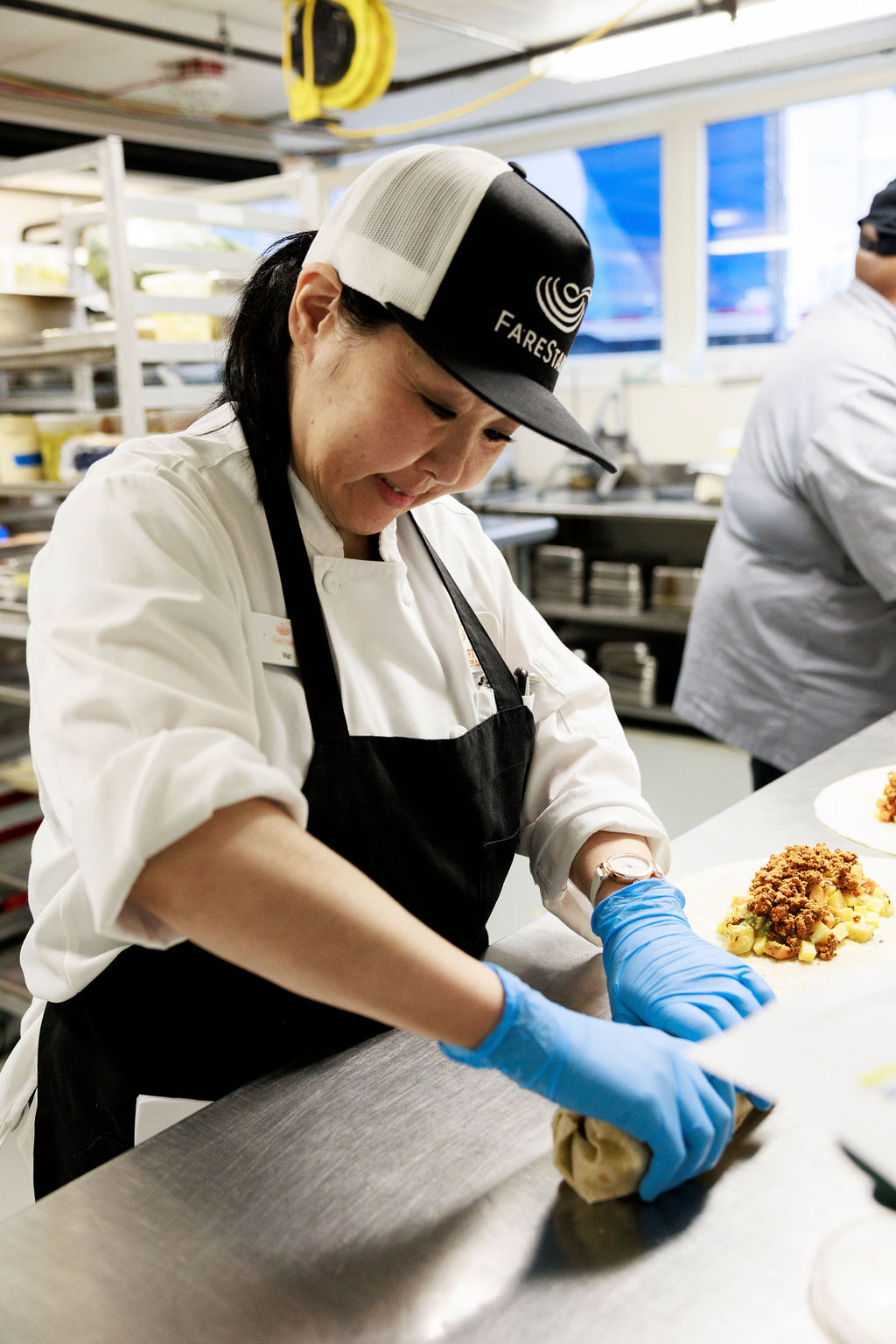
“I remembered I used to cook for people,” Mari said. In Japan she had signed on as a host through Kitch Hike, similar to Airbnb Experiences. She borrowed a friend’s bar during the day. “I was running the business.”
She applied to FareStart, and in January 2025, she began the Food Pathways Program.
Mari’s only sources of money had been plasma donation earning $300—rent was $700—and a tuition refund. Her church family helped her with food and rent. A $5 meal at McDonald’s was her occasional luxury.
FareStart provides students with a $1,200 monthly stipend, which “felt like a miracle,” Mari said. The money restored her sense of agency, her positive outlook, and her dignity. She could pay her own rent and eat well. Beyond that, she could study and otherwise focus on rebuilding her life without the constant stress of survival. “It gave me the emotional space to dream again,” Mari wrote.
Mari was amazed to find such a well-regarded program a short bus ride from home, with a stipend and the promise of certification.
This pre-med student appreciated FareStart’s attention to food safety and hygiene: the sanitary bucket; the different colors of cutting boards for only meat and only vegetables. (She can’t believe Seattle restaurants are allowed to operate with an “okay” food safety rating—and that people still eat at them.)
She was drawn to moments of quiet leadership, such as everyone working together to protect the food during a power outage at FareStart’s Community Meals kitchen in Interbay, where meals are made for local nonprofits.
She loved the excitement of working alongside professional chefs on Guest Chef Night and what she learned in the classroom training for job interviews.
But most importantly, Mari said, FareStart taught her about herself.
The kindness, consistency and encouragement of teachers like Chef Jessica showed Mari her potential. “Everyone here has a very positive and welcoming heart, a good mindset. That helps me A LOT,” Mari said. “I learned that I’m resilient. Even after hardship, I can grow, lead and help others.”
She found it empowering that FareStart students are not just receiving help but, through the food recovery and community meal aspects of the program, also helping others.
“It reminded me that I still have value, and that by participating in this program, I can be part of a larger effort to create change,” Mari wrote. “That shift—from being a recipient of support to becoming someone who can give back—has been one of the most important transformations in my life.”
‘Zeal in my heart’
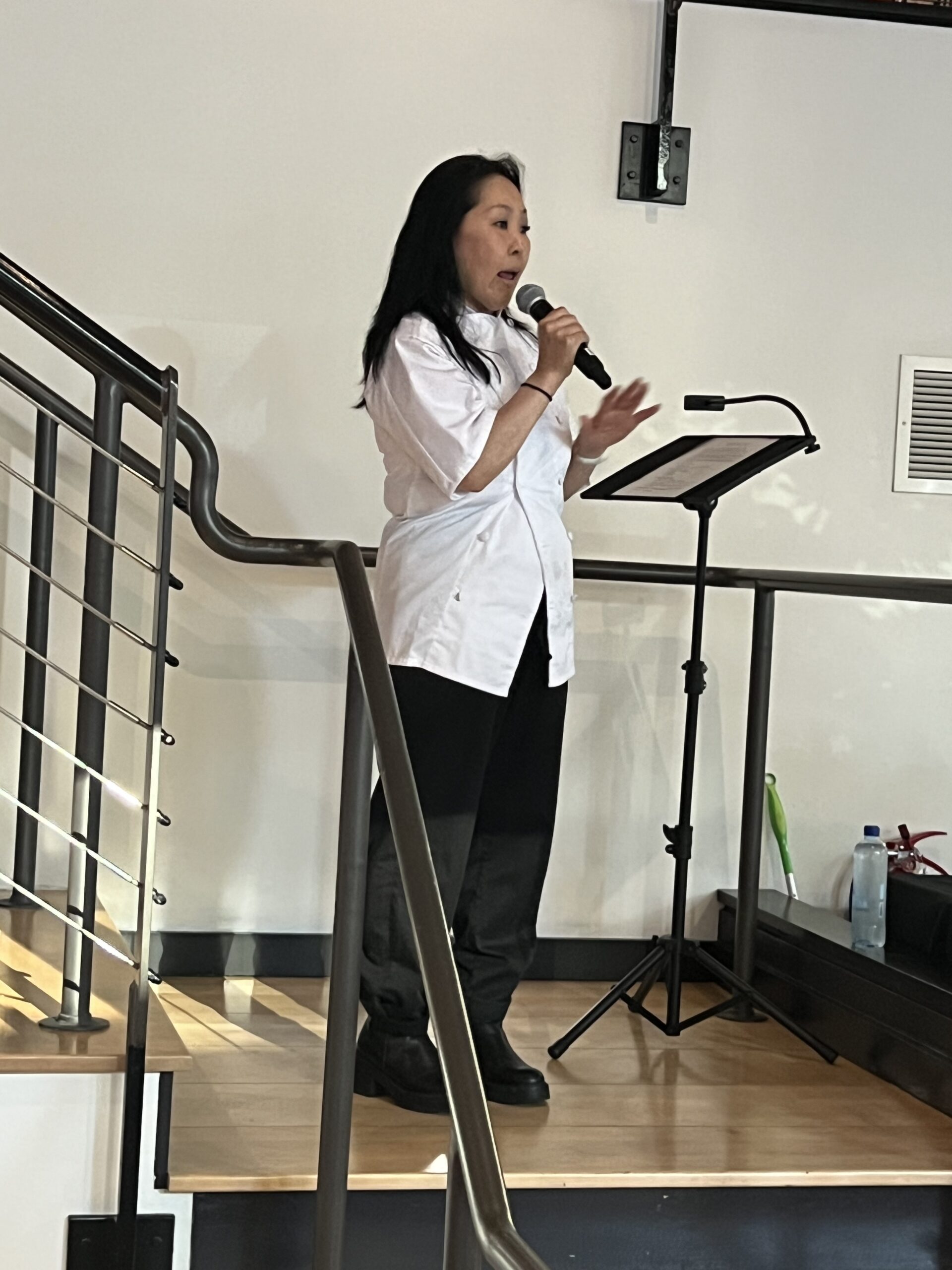
Today, Mari is working as a line cook at a highly rated cafe. She can see running her own restaurant someday (with an “excellent” food-safety rating, of course), in part to earn the tuition for medical school.
“I strongly recommend FareStart to everybody,” Mari said. “They don’t have to be a chef or cook. It’s not just job training. It’s life training.”
She’s also back in school, studying public health online at BYU. Mari is fired up learning about how food, public health and global health are interconnected as she writes papers on obesity, maternal mortality and global standards of health. “It’s really obvious that food is related to health problems,” Mari said.
She remembered how the stress of caring for her sick mother led her to an eating disorder in her teens, later resolved. Food is even what confirmed her mother’s Alzheimer’s disease: her mother insisting she’d never eaten a favorite dish; what was it? Mari also saw how her mother’s blood-pressure medication reduced the oxygen to her brain—medication she wouldn’t have had to take if she’d known to change her diet.
“When I’m studying global health or food, I feel zeal. I want to know more, more, more,” Mari said. “When I feel zeal in my heart, that’s my mission.”
Her interests could combine into any number of careers, but her mission is clear.
“The community deserves good food and good service and good health,” Mari said. “I want to provide those things.”
Mari also knows what she doesn’t want: to be the maid of a husband or be typecast by gender in any area of her life.
“This is my second life,” she said. This time, Mari will make her own dreams come true.
To date in 2025, has enrolled over 175 students across all job training programs. FareStart students come to us with diverse life experiences and a wide range of barriers to employment, each seeking a fresh start and a path forward. Read more stories here.